Wednesday, May 30, 2012

Batik


This is a blog post a few months in the making: caranya membatik. How to batik. 

I can't remember exactly how this all got started, but one day I went to a batik shop in Yogya with my second host father and came home to Karangjati with a bunch of supplies. After that I spent a good number of hours after school drawing patterns on cloth with melted wax (called malan) using a batiking tool called a canting.


     There are many different sizes of canting, meaning the spout of the tool is larger or smaller depending on how detailed you need to be. I was told by an SMKI teacher that the canting should never be out of the malan for more than 15 seconds (which is longer than it sounds). I've found this is a good rule to follow because it makes sure the wax you're using is always hot, and it lessens the chance that you'll drip. A canting isn't an advanced tool; it's made from a piece of wood and thin metal cup/spout attached with wire, so if you let it sit over the cloth long enough, it's bound to drip. (And I am much too familiar with this, as you can see in the picture above). In order to batik, you dip the canting cup into the malan, fill it about half way or less, then directly draw it on the fabric. If the malan is too hot, it'll run out of the canting in a continuous stream; if it's too cold it won't come out at all. So you have to watch the consistency of the wax and adjust accordingly.
     The other necessity for batiking is the kompor, or burner. This is also not very advanced; the one I used was made of tin (and cost around four dollars). There are six strings dipped in oil that you light by hand, and a small lever to raise or lower the string tips to control the temperature (in theory). The kompor is sometimes frustrating- not heating evenly, or becoming too hot even at the lowest setting. Electric burners work much better, these are what they used at the professional batik shop where I once took a batik lesson. What would be better yet is an electric canting- looks like a hot glue gun- but these are expensive by Indonesian standards (over 30 US). And I figure if I'm going to learn to batik the traditional way (called 'tulis' or 'written' as opposed to 'cap' (stamped) batik, or the printed kind) I should use traditional tools. (I suppose the most traditional would have been using a ceramic, wood-burning kompor, like we used at the SMKI cook-out... That would have been a bit complicated though). 


     There are two different kinds of malan that they sold at the batik store- brown and a lighter, clearish kind. Now, the picture above looks like I used both kinds, but that's just because the malan gets increasingly darker as it cooks in the kompor (I always bought the brown malan). Also, I admit, I liked to bake the heck out of my wax when I was first starting because the hotter the wax, the faster it spreads on the fabric, speeding up the whole process. This resulted in some messy lines and dark malan. I don't know if it will make a difference in the dying process, using well-done malan to batik, but hopefully my laziness didn't cost me too much. When I was first starting to batik everyone told me batiking was an art of patience- you have to work slowly. I thought I was all over the 'patience' thing, but as I got more practice and started caring more about the results, I stopped to change the malan in the canting more often (actually following the 15 second rule) and used cooler wax. You can see the difference between my first cloth and my last, too. Neater, less drips. 
    Now for the dying process. 
   Like I mentioned before, I took a short class at a batik shop (this was after I had started batiking at home, though another inbound signed up to take a class so I tagged along), and that was the first time I saw the batik dying process. It was intimidating, to say the least, particularly mixing the dye. There was a table full of little bags of white powder and a scale, and one of the workers would take spoonfuls of one powder, weigh it, then add another powder, weigh it again, take some away... As an Indonesian would say: pusing. Gives you a headache. After that I started thinking that I may not want to dye my fabric at home by myself- after all the hours I spent drawing on the wax, it'd be a pity to ruin the results because I'm a novice dyer. At this particular batik shop, they dipped the fabric in water first, then dipped it in another clear liquid, then dipped it in dye. For the first two steps, the fabric soaked just in plastic buckets but the color dye was poured into a hip-height cement trough and the fabric was pulled through the dye about six inches at a time until the whole pieces was colored. Then the fabric was hung on a line to dry for a few minutes, and if the color wasn't dark enough, they'd pull it through the dye again.


   Since I finished all of my wax work right before I changed houses, I enlisted the help of my third host mom to find a batik place that would dye my fabric for me (she took me to the place in Tamansari she regularly buys batik 'paintings' from). Here, they did a slightly different dyeing process. 


     First, the fabric was stretched and pinned onto a bamboo frame, then soaked with water. Pak Widoto (the person doing the dyeing) used a towel to wipe off the excess water, then started applying the dye. 
     

     He used a sponge to apply the dye, then used his fingers to blend the colors together (I chose to do two different types of blue). I'm not sure if this was the same type of dye as at the first shop, but it's machine washable, which is a plus. There are certain batik fabrics that are hand-wash only (which wouldn't be too big of a deal since I'm already experienced in that particular area :) ).    


     After finishing putting on the dye, Pak Widoto said we have to wait until the fabric completely dries,  soak it again with water, wait for it to dry, then finally boil off the wax. This part I didn't see, but I did get a glimpse of it at the first batik shop. The fabric is put into a big metal pot of boiling water, stirred around with a stick for awhile, then taken out to dry. Fingers crossed my batik turns out well! I really like how the pattern looked with the gold wax and blue dye, but hopefully it looks just as good when the motif is white (after the wax is gone, leaving the plain white fabric). We should be picking up the final product in the next few days. Pak Widoto said it'd be ready by Monday or Tuesday, but my host mother Bu Dwi said, for the Javanese, that means Wednesday or Thursday. 
    To round out my post, as always, I have to add a piece about food. Last Friday I finally met a chance to redeem myself, though it wasn't fish brain this time but goat brain (either goat or sheep, Indonesians call them both by the same name). I went to a street-side food stand that sold sop kaki kambing- goat foot soup- and just about every other odd piece of meat/tissue you can find on a goat, including the brain. My host father and I bought a good mix of everything  and brought it home, where I carefully fished out a piece of brain from broth. It was a modest chunk, white and squiggly, and it turned right to mush in my mouth, like a cracker that's been left in soup for too long. I managed to eat the one piece, but I definitely didn't ask for a second taste. Now, I've eaten intestine with rancid smelling I-don't-want-to-know-what on the inside (and that tasted awful, really) but brain is still something that I'm less than enthusiastic about putting on my spoon. It doesn't even taste bad, but still makes my insides squirm, and that's frustrating. I suppose that's something I just have to accept. Brain isn't my thing. 
    For my little time remaining in Indonesia I have several more events on my culinary agenda, so stay tuned. I'm experiencing a last minute burst of blogging energy- I still have so much more to tell about my experiences here in Yogya before I'm a plain old American again. 

Until next time! Sampai jumpa!


Saturday, May 19, 2012

Borobudur, Prambanan, dan Rendang

     Last weekend I visited Borobudur for the third time, but I still have yet to post a blog about it. Pemalas. Lazy. However it works out well now that I just got back from Prambanan, the other major temple in Yogya, so I can blog about them both in one post. According to everyone I've talked to, foreigners and Indonesians alike, Borobudur is big but Prambanan is more beautiful. In my opinion they're both stunning, but I happen to like Borobudur better (the park is better kept and the temple and surroundings are more photogenic).
   Borobudur is a Buddhist temple about an hour north of Yogya, and Prambanan is a Hindu temple located on the east side of the city. Every month at Prambanan there is an outdoor performance of Ramayana, a long Indonesian mythical story (depicted through traditional dance) which I hope to see in the next few weeks. Here are a few pictures of each temple:

 In order to read the carvings of Borobudur, you walk around the temple clockwise, starting from the bottom.
There are nine levels to Borobudur, and the progression from the bottom level to the top of the temple represents ascension to Nirvana. 


The view from the very top.
Candi Prambanan


This is the biggest temple at Prambanan, dedicated to Shiva.

Surrounding the primary eight temples of Prambanan are ruins from other smaller, uncovered temples. The legend of the Prambanan temple complex, briefly, is that a princess was ordered to marry the person who had killed her father, so she said that she would marry him only if he could build her one thousand temples in one night. Her courter then called upon his own dead father and enlisted the help of ghosts and demons to build all the temples. My host father told me that if I ever get proposed to, I should ask the guy to build me a thousand temples, and see how it works out. 

     Now for a quick change of subject: last Thursday I got the chance to take another Indonesian cooking class. This time I cooked for real, not just make snacks. I went back to AKS and learned to make nasi kuning, nasi kebuli, arem-arem, tempe kering, sambal kelapa, and rendang. Nasi kuning (yellow rice) is served at celebrations (it's shaped into a tall cone and someone important is chosen to take out the first scoop. If you remember the SMKI 50th birthday celebration at the very beginning of my year, I served the first cut of nasi kuning to the sultan of Yogya but didn't understand what was going on. What? A mountain of rice? And where am I supposed to take it?) and generally it's paired with tempe kering and sambal kelapa, along with other dishes of choice. So now I can cook myself a traditional Indonesian welcome home party when I get back (though I'll have to guess at how to shape the rice into a cone...) Nasi kebuli is rice cooked with several different spices, an Arab dish. I've been wanting to make arem-arem all year (rice filled with spicy shredded chicken, wrapped in a banana leaf and steamed) and turns out it's really easy to make, but really difficult to wrap. My hopes of making arem-arem for my extended family have been extinguished- though perhaps it'll be easier to fold and skewer a corn husk than a banana leaf (I figure this would be the closest substitution). 
     The highlight of my lesson was rendang- said to be the most delicious food in the world. Rendang is a combination of spices and coconut milk that you can cook with meat or eggs (the most well-known is with beef) and you boil it down until it makes a thick pasty coating around whatever you're cooking. The first time I tried it I was certainly taken aback- the flavor is Intense and almost hurt, like when you eat too many Sour Patch Kids- it wasn't spicy in the chili sense, but had so many other spices that it was like a flavor bombardment. The rendang I made at AKS was the same way; my host mother said I should make the spices a little less strong if I cook it in the States, so people can enjoy it :) I think I prefer the spice explosion on my palate, though. 
     And you're due for an update: I changed host families a week ago, so I'm now living in Yogya again (actually, only a few streets away from my first house). I'll admit I'm sad to leave village life behind. I miss boiling water in the morning for my tea, and washing my own dishes and clothes. I guess that means I'm a creature of routine. But I am very happy in my new home with Bu Dwi, Pak Benny, and my two host brothers Mas Aldi and Ardi; I just have to wait to build a new routine back in the city. And I have to say- air conditioning is so nice. 
   That's the news for now. I hope everyone is enjoying the summer back in Minnesota! I have to wait a few more weeks until my vacation starts, the last day of finals at SMKI is June 12th. I'm looking forward to testing time, just because I think I'm going to do fairly well (and there's no pressure because I don't actually get graded. How do you think traditional dance scores would transfer anyways?). I'll certainly let you know how things go :)

Sampai jumpa semuanya! 


Wednesday, May 9, 2012

Belajar Bikin Kue Tradisional


Now that I only have a few weeks left here in Indonesia (a few weeks, is that right??) I’ve been thinking about everything I’ve done so far, and what I have yet to do in the little time that remains! Ah stressful. But in the best way possible.
            Before leaving Minnesota, I had made a “To Do List” for my exchange year here in Indonesia- and I don’t think I even brought it with me. I don’t know if I’ll be able to recall all ten goals, but this is a good time to go through it and see how I’ve done so far.
            Firstly, ‘Learn bahasa Indonesia’ was surely on my list, and I think it’s safe to say I can check that one off (thankfully- I remember when I first arrived here and I was so frustrated with not being able to communicate. I had also thought that Indonesian would ‘just come to me’ after awhile, since I had heard it was such an easy language to learn, but that turned out to be wishful thinking). Also on my list was ‘learn traditional dance’. Double check that one, and write SMKI afterwards circled with a big heart. Now I’m not sure, but fairly certain, that ‘learn to cook Indonesian food’ was on there- which leads me to my main point for this post…
            Around the middle of my exchange I had mentioned to a Rotarian that I’d like to learn to make Indonesian kue (translates to ‘cake’, but this can mean anything from a popover to jelly snack) particularly because one of the Yogya Tugu Rotarians owns a bakpia bakery. One of my very first posts about food here mentioned how I liked bakpia, and I really wanted to get the recipe. The trip to the bakery never worked out, but I did get quite a good replacement: lessons at AKS, a vocational academy for cooking, sewing, and hairdressing/cosmetics, and visits to three different kitchens to learn to make an assortment of snacks, kue lapis, and moci. Good thing I had five days off of school so I could fit this all in!
            First I went to the snack shop owned by a friend of the Yogya Tugu Youth Exchange Program coordinator. She runs a small shop, but also distributes to markets around the city, and caters and fills private orders. Here I helped make risoles, martabak telur, kroket, and lumpia. These are all fried snacks- the martabak and lumpia use a stir fry filling and are wrapped in a thin pancake, and the krokets and risoles are potato dough mixed with veggies or minced meat and then rolled in bread crumbs. I also watched the making of roll cake and ‘brownies’, which aren’t like American brownies at all, but just chocolate cake. One quick note here: Indonesians love to mix chocolate with cheese. I thought this was so odd when I first arrived, but it’s become a normal sight. And if you ever make it over to this side of the world and order cheesecake, just know you won’t get a heavy cream cheese pie, but a frosted vanilla cake with shredded white cheddar cheese on top. They also make many other snacks and pastries which I hope I can learn how to make, too, at some point.

Here's the Indonesian brownies and cheesecake, as well as a danish, risoles, lumpia, kroket, fruit pie, pisang goreng (fried banana), macaroni, and what I think is called suis (like a bite size chicken salad sandwich).
            Next, on to AKS. Here I worked with Suster Maria Angela, a nun who teaches cooking classes at the academy, and together we made mento, dadar gulung, talam ubi, kelepon, and onde-onde. One thing that I’ve learned about Indonesian cooking is that there are usually a ton of spices, and none of them are in powder form. This is good because it means all the spices are fresh, but it also means you have to prepare most of them using a mortar and pestle. Turns out crushing spices is hard work; I’m not very good at it. A lot of recipes use garlic and you have to smash the cloves into a paste before adding the other ingredients- for me that’s the hardest. Pepper is pretty difficult, too, because the kernels like to fly off the mortar when I’m attempting to crack them into powder.

Suster Maria crushing the mento spices (because I was taking forever) at AKS. If you can see on the table there's fresh daun sirih, daun jeruk, jahe, merica, and other spices.
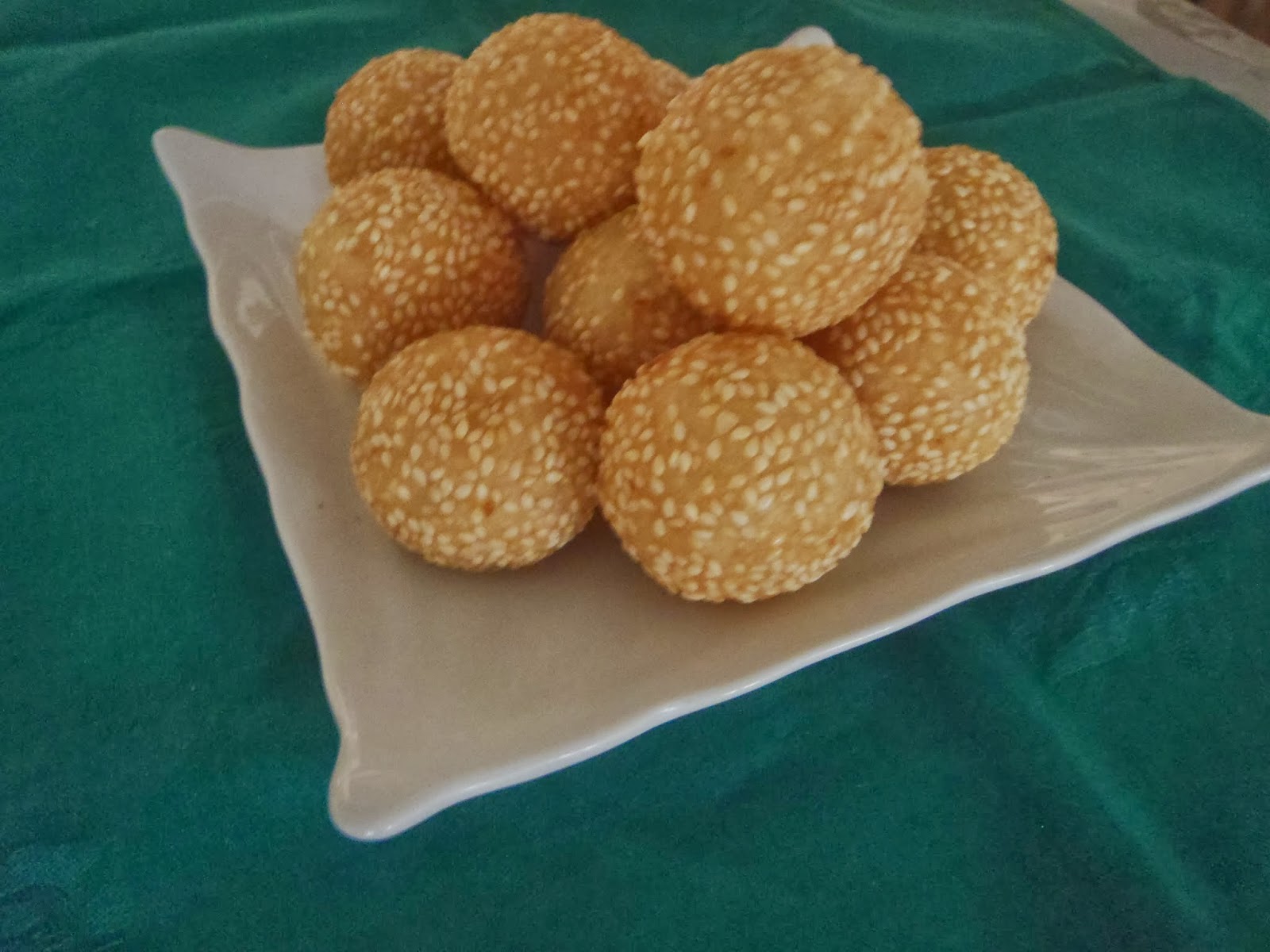
            So technically these were lessons to just make snacks, but the recipes sure took a long time to complete. Now, dadar gulung and mento are basically the same thing, filling wrapped in a thin pancake, except the first is filled with coconut and the mento is filled with chicken stir fry, then covered in coconut sauce and wrapped in a banana leaf and steamed.  Talam ubi is a funny Jello-like snack half flavored with coconut milk and half with ubi (like a sweet potato, but bright purple). Kelepon looks the weirdest- small green balls of rice dough filled with melted gula jawa (palm sugar) and rolled in coconut flakes. Lastly, onde-onde is simply fried dough filled with mashed soybeans. Notice all the coconut? It tastes delicious, but also explains why I gained about five pounds during just five days, trying all these traditional snacks. This was also the second time that I’ve been told I should become a nun since coming to Indonesia- and Suster Maria said they have a convent in the U.S., too. We have plans to move there together and open up an Indonesian restaurant ;) If I ever do get around to becoming a nun, anyways.

Mento 
Mento after being wrapped in the banana leaf
Talam Ubi

Onde-Onde
All of my snacks for the weekend- the dadar gulung are the green wraps on the plate, moci is the white balls in the middle, then kelepon are on the far right. 
            The kue lapis and moci visits were just to watch, but I hope to get back to the moci place sometime to actually learn the process start to finish. Moci (pronounced mo-chee) has a very odd texture, though I like it. It’s made from tepung ketan (glutinous rice flour), sugar, and water all mixed together, and becomes stretchy and sticky like raw dough. Traditionally the moci is rolled into sheets, covered with chopped peanuts and then rolled and cut into bite size pieces. This particular seller uses jelly, too, as filling (my favorite is lemon).

            So I’m glad I put Indonesian cooking on my to-do list. It turned out to keep me quite busy, as I hope to continue the visits/lessons in the coming month. For now, I think I can check this one off the list. I hope the next item to be checked off will be ‘learning to batik’, but I still have a bit to go before finishing that one. Once I have a finished product, I’ll post about the whole process and such. Going further on down the list, I know there are two items I’ll have to scratch out, because I won’t be able to do them this year. The first is surfing- I’ve mentioned before that the beaches around Yogya aren’t suitable for swimming, let alone taking beginner’s surfing lessons, and I don’t think a trip to the good surfing beaches is in the cards for me. The next is hiking up a mountain/volcano. Ahhhh I wanted to do this so bad, and I’ve asked about it multiple times but it seems like there’s no way to make it possible. The road and trails up Merapi are still closed from the last eruption, which would have been my go-to volcano, and it doesn’t seem like the Rotarians are crazy about me going out trekking in the jungle outside of Yogya. Sigh. We’ll save this for the return trip in a few years I suppose.
            There are other items that will have to be scratched out as well; I think I had one about visiting Aceh or some far away part of Indonesia that’s a long shot, and I’m still holding out for a chance to go snorkeling or diving but who knows. I’ll have to ask my parents to dig around at home for my list (it’s odd to think I still have a bunch of stuff sitting on the other side of the world…), though more likely I brought it with me here and lost it. Dia agak pelupa, my host sister often says about me. I’m a little forgetful.
            I certainly had some big dreams while writing my list. At the time I really had hoped to do all of those things, but I feel like my exchange has still been more productive, rewarding, and out of the ordinary than I ever expected, regardless of whether my To Do boxes are all checked off or not. There’s so much more to a student exchange than the sum of individual activities or trips. I’d have to say I’m more proud of becoming accustomed to using the bathroom here than getting to lay on the beach in Bali- give me a bucket of water and a pail and I can shower in under ten minutes. Now that’s remarkable.

So I’ll keep on moving down my list of goals and quietly pass over the ones I now know to be unfeasible, impractical, or simply superficial, and I won’t feel any less fulfilled. I’ve learned to thrive in a foreign country and that’s all I ever wanted. Tetap sukses. Next June I’ll come home laden with incredible pictures, clothes, and an assortment of other new items that I've harvested throughout my year, yet it’ll be the journey of learning that is the true treasure. (Because nothing builds character like learning how to use a no-flush, in-ground toilet.) 

Sampai jumpa!

Saturday, April 28, 2012

Bali


Just got back from Bali yesterday morning, and I figured if I don’t get a blog up this weekend I never will, so here is the news!
            The trip to Bali was with the freshman class at SMKI (which happens every year).  Bali is also called Pulau Mimpian or “Island of Dreams”, and it was indeed very beautiful.
     I thought the best part was all the Hindu temples- they are everywhere.  The most common temples are small and consist mainly of a shelf to place offerings; there are many along the side of the road to give safe travels. Offerings are placed in small wicker baskets, and can contain flowers, sweet bread, and other things. Offerings are supposed to be given every day, and I only saw Balinese people doing this in the morning (always in traditional dress) but I’m not sure if that’s a rule or just routine.


The temples in Balinese homes are even more remarkable. There are usually four or more temples built in the yard or on the roof, and they have statues of various Hindu gods above the offering shelves. The most stunning ones are topped with gold and sparkle wonderfully in the hot Balinese sun. Temples are generally wrapped in a sacred cloth, either plain yellow or black and white checked. I was told that the black and white symbolizes the daily presence of good and bad, but I'm not sure the meaning of the yellow. Occasionally there will be tree trunks wrapped in black and white checks, and this is where a new temple is going to be built. If there are regular unusual occurrences (for example frequent recurring deaths) in a certain area, Hindus believe this is because not enough offerings are being given to the gods, so they wrap the cloth around the trees to make the place sacred and then build a temple there.
SMKI visited a notable temple during the trip called Tanah Lot. Tourists weren’t allowed to walk up and enter the actual temple, but could make flower offerings (for the price of few thousand rupiah) either in a cave on the beach or in a cave on the temple island, though the last one requires a short wade through the ocean. After tourists make an offering, the temple-keepers (there is surely a special name for this, I don’t know it though) stick some grains of white rice on the tourists’ foreheads and put a flower behind their left ear. Perhaps this is just to entice people to make offerings, but it still looks lovely.

Temple surrounded by ocean.

This is the entrance to the cave where tourists could make offerings for Tanah Lot.

Despite the thrills of touring, the main event of our trip was to visit SMKI Bali and share performances there. Their school campus is gorgeous and clean, even the outsides of buildings, which is a rare occurrence in Indonesia. There is also an SMM (music school), and SMSR (‘seni rupa’ it’s called; “looking arts”. Maybe there’s a word for this in English but I don’t know what it is, or don’t remember. Anyways, it’s a school for painting, graphic design, woodwork… Macam-macam, many kinds).

The SMKI Bali karawitan performances were mesmerizing- you can see the drummer and first row of players on the left side of this picture- I simply love the dynamic quality of Balinese gamelan. Here is a two-man costume that was incredibly intricate and surprisingly life-like; the dancers inside were great at expressing the different moods of the character.


We also stopped at a traditional Balinese house that belonged to one of the SMKI Yogya teachers. There were around eighty students on the trip and we were all fed lunch here- a delicious (and fiery!) rice dish with salak for dessert.


And of course you can’t visit Bali without going to the beach! We visited two: Tanjung Benua and Pantai Kuta. The first was filled with mostly Asian tourists, and most everyone was there to go parasailing or boating. I went out on a glass bottom boat ride with a few friends where we fed bread to some small fish above a reef and then boated to a petting zoo on a small island offshore.  

Tanjung Benua
The glass bottom boat with Bu Yati and some of my XT1 classmates.

On the way to the petting zoo, we passed a temple with its entry opening to the ocean.

A large bird and I at the island petting zoo...

Pantai Kuta was so different- packed with tourists from around the world and almost everyone was surfing. Don’t get me wrong, I enjoyed my time at the beach (even got a pretty good farmers tan) but it made me want to be an American again so badly (figuratively speaking). Good thing I didn’t bring a swimsuit with me or I may have been overcome by temptation- I was incredibly jealous of everyone wearing bikinis, swimming, and tanning… Sigh. But there will be time for that later. I sat in the sand with my Indonesian buddies- they were wearing sweatshirts, sweaters, long jeans, and hats to protect their skin from the sun- and we people- watched for awhile. A few girls paid 10.000 rp to have their nails painted by an old Indonesian lady working the beach, and a group of students played in the waves (the teachers weren’t very happy about this, later the buses were full of sand and smelly with all the damp clothing).  Overall, a nice visit. I’m excited to show off my not-as-snowy-white skin when I go to school again J

A quick note about bahasa Bali, before I move on. Bali is a 45 minute ferry ride at most from Java, but Javanese and Balinese sound nothing alike. If you take the Javanese alphabet HA NA CA RA KA (pronounced ho no cho ro ko) and say it with a Balinese accent it becomes huh nuh chuh ruh kuh but with an odd nasally sound, like when you say une in French. Odd, no? So for example when our tour guide would say Pantai Kuta it sounded like Kutuh.

Near the end of the trip, we visited a beautiful lake in central Bali. I have painstakingly racked my brain for the name of the lake, and even requested an itinerary sheet from the trip, but to no avail. We all stopped to eat lunch at a lakeside restaurant and then visited a nearby fruit and traditional Balinese snack market. I bought a kilo of salak Bali (Balinese snakefruit- just found out it was called ‘snakefruit’ in English; I had never heard of it before) and a small carton of teeny strawberries, grown just down the road.  All the students say salak Yogya is better because it’s sweeter, but I like salak Bali because the first time I tried it, the taste reminded me of the very tip of strawberries in Minnesota, a bit sour. Surprisingly enough, the Balinese strawberries had no taste at all. So I’ll stick to salak from now on.

After mentioning the fruit market, this also brings up another recent undertaking of mine in my Indonesian exchange: haggling. Eeeeveryone haggles here, and I’m just starting to get the hang of it, though more often than not I still pay more than the average Indonesian. I find that, in general, people don’t want me around when they’re haggling a price. If I do happen to tag along, they manage to make a deal so quietly I always miss the selling price, and when I ask what price they settled on I usually don’t get a response. At first this was frustrating- a big problem for me is that prices are usually so cheap anyways (compared to the States) I don’t haggle as low as I should, but I can never figure out what a good deal is because everyone is so secretive when I’m around. And then after my purchase is done people ask me what I payed : “Andrea! Tidak usah sampai harga itu!” everyone says, "You don’t have to pay such a high price! I got the same for… (always lower than what I paid)…" I did have a few successes while on the Bali trip, thankfully. There was a theatre student who paid 8.000 rp for a carton of strawberries which I got for 5.000 rp, and I managed to get the same price for a souvenir at a large arts market as another student as well. Ha! So it is possible, though surely difficult. The key is to not look rich and not look foreign. Everyone started telling me I need to dye my hair black in order to blend in, but somehow I don’t think that would help much…

We also visited Patung Garuda Wisnu Kencana- an unfinished park of statues that also holds Balinese dance performances for tourists. 


This is an incomplete Balinese gamelan (or perhaps a different type of traditional music ensemble) that performed at the tourist shows in the park. We watched a phenomenal theater performance by a group of students from a school for the deaf. They were perfectly coordinated and very expressive; it was a treat to watch. At the end, there was a female Balinese dancer in traditional garb that would dance and invite different spectators to come on stage and dance with her. She was pleasantly surprised when an SMKI Yogya student walked onstage and began dancing tari Bali with her! I suspect that they rarely get audience members that are able to dance traditional Balinese-style. 

Looking back to when the Bali Rotary Inbounds visited Yogya, I remember they said that the Balinese like three types of food: really spicy, really sweet, and peanuts. I have yet to try the spicy and the sweet, but peanuts are definitely a big hit there. Every souvenir shop sold several different kinds but the most famous is kacang asin, which is said to help women conceive and produce milk. I didn’t try any, but asin means salty, so I’m guessing it’s not far from, well, the average salted peanut. Things on my list to try when I go back to Bali (and this is indeed going to happen, someday): ayam betutu (Bu Yati said it is like opor, which means the chicken is boiled in coconut milk but it’s very spicy) and babi guling (pork).  It was odd to see signs advertising pig meat at first- I’ve never seen a sign for pork in Java and whenever my host family talks about it, they always bring it up in a whisper (because of the Muslim majority). Anyways, I don’t know what guling means, but I hope it means ribs. Yum.
While on the subject of food, I’m going to back track a ways and throw in the latest adventure: eels. Maybe baby eels, since they were so small. This culinary opportunity came about when I went to the restaurant Pecel Solo with a few Rotarians about a week ago. At first sight I knew I wanted to try it. I thought it was snakes, but when I asked what it was “belut” was the response and Bu Clara clarified ‘a type of fish’ in English. I figured it meant eels. Sadly, there was no taste, like the cow lung. I think this was the result of the eels being so small to start with and then deep fried.


Pecel Solo

To wrap up, my lovely Balinese experience is over, and now I’m back to my regular school schedule. We’ll see what the next few weeks bring- final exams are coming up at the end of May so my days at SMKI will most likely be business-only for the rest of my time here. But can I really say that traditional Yogya dance classes are strictly business? Every day here feels average, but when I take the time to stop and think I’m always reminded of how luar biasa this experience is. Certainly out of the ordinary J

Hope to write again soon, there’s still more I have to catch you up on.

Sampai jumpa!

Saturday, February 11, 2012

Sudah Lama...


It’s annoying how easily time slips by- it has already been over a month since I’ve last posted. We have a lot to catch up on, so let’s get right to business, starting with February.
          About a month ago, there was a large ceremony for the closing of Sekaten at Kraton. I think I mentioned before that there has been a carnival set up outside of Kraton called Pasar Malam. This fair has been going on for about the last month, and the final week is called Sekaten. The whole celebration is to commemorate the spread of Islam to Indonesia. There is a gamelan set that is kept in Kraton and brought out only during Sekaten- so it's only played during one week each year. Last Saturday afternoon I watched the last performance using the special gamelan set, then on Sunday watched the closing ceremony. This consisted of five large 'mountains' of fruit (like the the one at Bekakak, but much bigger) that were carried through the street that circles Pasar Malam then taken into the palace at Kraton. I was waiting outside the gates of Kraton, so by the time the mountains of fruit passed by, one was already completely finished (the pieces all given out to spectators). The majority of people that come to watch the closing of Sekaten are Javanese villagers who come with hope that they'll catch a piece fruit- not to eat, but to plant in their fields at home, to make the soil rich and fruitful.

  As for the Chinese New Year, my performance for Imlek fell through but I did get to see a little bit of the celebration. There were several big paper dragons waved around by a crew of men in Chinese costumes, as well as furry dragon suits filled by two men each (these were more lifelike- flapping ears, eyes that blink, a working mouth) that you 'fed' a small envelope of money to give you good fortune for the coming year. 
          Also at the end of February, the Rotary Club Yogyakarta Malioboro (I am hosted by Yogya Tugu) held an arisan with Tahun Naga as the theme, and all the Yogya inbounds performed a dance together. An arisan is like a small lottery where a group of people gets together and everyone contributes a set amount of money to make the ‘pot’. Then one of the group member’s names is randomly selected (pulled out of a hat or whatnot) and that person wins all the money. Arisans are quite common here, usually held once a month and attended by mostly old ladies as I’ve been told, but I have seen classes at SMKI hold arisans as well. The Yogya Malioboro club’s arisan is a bit out of the ordinary because it’s held once a year, has over 400 participants, and there is a raffle for gifts as well as the grand money prize. The raffle was preceded by an assortment of dancing and singing performances (including the inbounds) and a seven course dinner (definitely not your average arisan).
For a recap of ordinary events here, in school we have finished the super slow tempo dances and moved onto ragam routines. Ragam means "style" and in dance is used to describe a combination of moves that are always done in the same order (same as a time step in tap or a do-si-do in square dancing). Usually one ragam consists of eight or sixteen counts. For example, one of the most basic combinations in Yogya style dance is called sabetan, or ngabet in Javanese, and it’s used in male dances (so tari gagah and tari alus) but there are different versions for each style of dance. The first count you bend your knees then shift your weight to your right leg. (This is why it is so much harder to learn Indonesian dance while counting in your head in English, because each count is often split into two parts: sa-tu, du-a, ti-ga, em-pat, etc and you can’t split up one, two, three…) The second count you shift weight to your left leg then lift your right foot (always lifting the leg straight out, then bending the knee once your foot is in the air), for the third count put your right foot down and lift the left leg (straight, then bend the knee) and this goes on for eight total counts, with specific hand and arm movements, too. Most of the time a ragam will end with both feet back on the ground, but not always.
Now that was the first part of sabetan described in English, but in all my dance classes at school the combinations are explained using Javanese. Mendet= bend at the knees/squat; gedruk= tap the ball of your foot on the ground directly behind your other foot; ngoyok kiri/kanan= shift weight to left/right; tekuk= bend your elbow; njimpit= pick up sampur; seblak= flick sampur; catok=wrap sampur around your hand; kipat= unwrap sampur (comes after catok); cul= let go of sampur… So there’s an expansive vocabulary for dance moves that I’ve been trying to learn. Generally the teachers yell out these terms as we’re dancing to remind the students of what to do. It’s taken awhile for me to connect the words with the right movements (since you’ve got hands and feet going at the same time) and I still have lots more to learn.
The hardest by far, though, is memorizing the ragam names. If you write down the first part of the tari srimpi pandelori routine, it looks like this:
Sembahan sila
Ndodok
Panggel ngregemudet
Janokung miling
Nduduh wuluh
Lampah sekar tawing
Pendapan cangkel
So each of these names represents a set of eight or more counts (one ragam), but I admittedly don’t know where each ragam starts or ends in the dance. I’ve just memorized the series of individual movements. For tari putri, this method works well for me, but in my freshman tari alus class Pak Toro likes to yell out a progression of ragams (“sembahan sila jengkeng, impur jugag dua kali, gidrag, sabetan, kambeng dewa, tayungan tiga langkah, ombak banyu…) then put on the music and the class dances according to what he just said. This, I have trouble with. A week or two ago we had a tayungan test (which means you do a lot of ‘walking’ around, but the style of walking changes depending on what ragam the routine is based on) and each student drew the ragam they’d be tested on out of a hat. This was before I had started memorizing ragams- the piece of paper I drew had ‘kambeng’ written on it, but it might as well have been written in Arabic for how much meaning it had to me. I had absolutely no clue. So I used the first ragam I could think of (which was impur, not kambeng) and failed miserably (though I had a get out of jail free card since I’m the foreign kid). After that I decided I should start paying attention to the ragam names, at least for Pak Toro’s class.
Now that we’ve moved on to a routine designed specifically for teaching a bunch of different ragams (there’s got to be over a million, I swear) we’re learning about two or three new ragams a day. I have about three quarters of each freshman routine memorized so far (complete with the ragam names J) but it gets tough for me towards the end when certain ragams combine the foot movements of one ragam with the arm/hand movements of another. I think my muscle memory works with all my limbs paired together because the mix-and-match ragams are hard for me to master. Hopefully I’ll have a mental breakthrough by the time we have our mid test.
As for sophomore dance classes, I think I’ll be having a final test in tari srimpi pandelori in the next week or two (all 35 minutes finished!) and I just had a sophomore tari alus test where we used fake bow and arrows as props. In gagah we’ve started learning a 25 minute routine (which is a total killer for tari gagah) where we use a shield and club, and there are four dancers depicting a fight, just like the previous tari putri and alus routines. Needless to say, I’m tired at the end of each day, but I’m really enjoying my lessons.
As is routine, my most recent interesting food find is sate keyong or snail kabobs. Delicious. Sate keyong can only be found in angkringans (tent-like food stalls set up at night on the side of the road, they usually have a wide variety of dishes, gorengan, and snacks to choose from) meaning you can’t order it in an actual restaurant. It’s made with a spicy sauce, and the texture reminds me of cooked oysters. I’d like to see what color it is (I imagine a swampy green), but there’s never good lighting at an angkringan so I have yet to find out. Quite the opposite of my odd food ventures, I had my first bowl of milk and cereal last week since coming to Indonesia. I may be trying my very best to become Javanese, but there’s still some American left in me- a nice bowl of corn flakes and milk sure does hit the spot.
Since I’ve last blogged, I’ve gotten the chance to see Borobodur temple and a closer look at Merapi. (If you remember, I visited Kaliurang, the Merapi area, with Rotex one of my first weeks in Yogya, but that was at night and we didn’t get to see the volcano). This Kaliurang visit was especially memorable because we got to go with the Bali inbounds, who came to tour Yogya for a few days.


Inbounds and some Rotarians at Kaliurang


Merapi

Speaking of guests from Bali- one of the last weeks in February students from SMKI Bali came to visit their sister school in Yogya (there are eight SMKI’s throughout Indonesia I believe). There was a performance at pendopo with dance and karawitan in both Yogya and Bali style, and everyone got out of class to watch. It’s incredible how different the styles are. In general, I find that the gamelan music we dance to in class is muted and repetitive, the different sounds and instruments easily melt together (I actually nod off sometimes in class when I’m watching other kids testing- biar ngantuk, it makes me sleepy) but Balinese gamelan has just the opposite effect. There’s lots of Clang-Clang and Cheng-Cheng sounds of metal mallets pounding on sarongs and the drum beat is so fast I don’t know how on Earth the dancers can make sense of it (assuming they follow the drum like Yogya style, but perhaps not). And it is Loud.


When I first got here I was told Javanese dance is the most difficult of all Indonesian traditional dances, and once you learn this style everything else is easy. This came from an SMKI Yogya teacher so it could very well be biased, and after watching the Balinese dancers I’m not so sure I’d agree with that opinion. Balinese dance is much faster and uses eye movements as well as facial expressions which generally aren’t choreographed in Javanese dance. If I think adding head movements is hard, I’m sure eye movements and facial expressions would be a challenge to memorize as well. I’ve also never gotten the chance to study Balinese dance, so I suppose I’m not an accurate judge of which style is harder anyways.
Either way, I am Pumped to go to Bali and see more of the traditional arts there. I’ve heard it’s like another world in Bali- the culture and atmosphere is completely different than the rest of Indonesia, mostly due to the prevalence of Hinduism and large population of foreigners. But until then, I’ll try to keep you better updated on the happenings here in Yogya. I sure do wish time would slow down; I hope to savor these next few months like I’ll savor my first bowl of milk and cereal back in the States.

Sampai jumpa!